
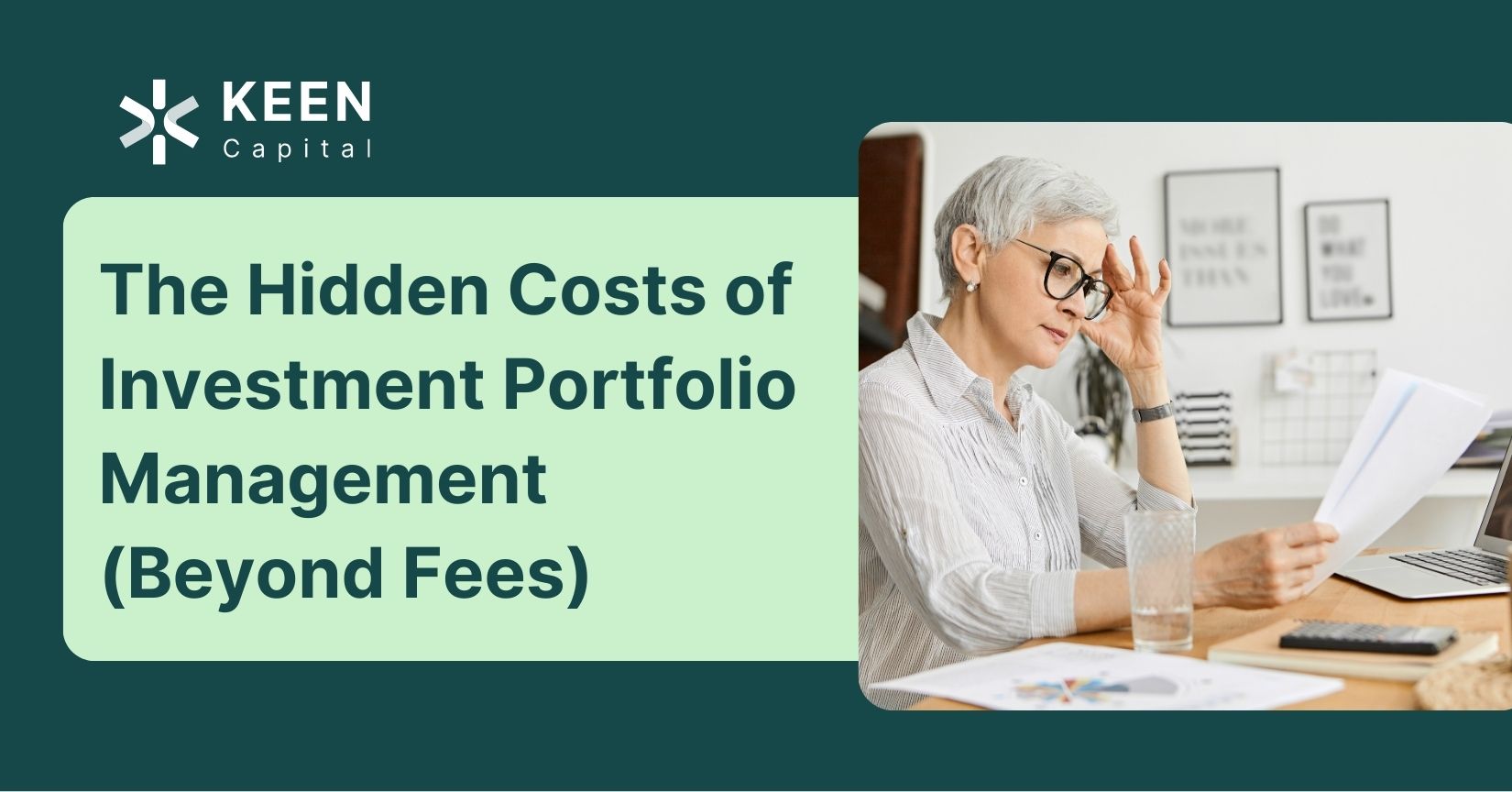
When investors review their portfolios, fees are usually the first thing they examine. Advisory fees, fund expense ratios, and platform costs are visible, comparable, and easy to focus on. It is natural to assume that if these numbers are reasonable, the portfolio must be efficient.
In reality, fees represent only a portion of the total cost of managing investments. Many of the most significant drags on long-term results never appear as line items on an account statement. They emerge gradually through trading decisions, taxes, portfolio structure, and the way capital is managed when markets are volatile or cash is required at an inconvenient time.
For high-net-worth investors, understanding these hidden costs of investment portfolio management is not about fine-tuning performance. It is about protecting flexibility, preserving purchasing power, and avoiding forced decisions that can permanently alter long-term plans.
What Counts As A Cost In Investment Portfolio Management?
Investment costs fall into two broad categories. The first is explicit costs, which are charged directly and disclosed clearly. The second is implicit costs, which are not billed but still reduce what an investor ultimately keeps.
Explicit costs are easier to measure and control. Implicit costs are harder to see, but they also have a large impact over time. Together, they determine the true cost of managing an investment portfolio and help explain why portfolios with similar market exposure can produce very different real-world outcomes.
Explicit Fees And Charges Investors Can See
Explicit costs include advisory and investment management fees, whether charged as a percentage of assets or as a flat fee. They also include fund expense ratios inside mutual funds, ETFs, and private investment vehicles. Custody, reporting, and platform fees can add another layer, particularly when portfolios span multiple accounts or providers.
Trading commissions and foreign exchange fees also fall into this category. While these costs are smaller today than in the past, they still matter for larger portfolios or strategies with higher turnover.
These expenses deserve attention, and for most high-net-worth investors, they are simple to recognize and address. However, they are more complicated fee layers that can create dramatic portfolio drag that are not easily identified.
Trading Costs That Do Not Appear On Statements
Every trade carries a cost beyond commissions. When a security is bought or sold, the investor pays the bid-ask spread. In highly liquid markets, this cost may be small, but spreads widen in less liquid securities and during periods of market stress.
Trade size and timing matter as well. Larger trades can move prices against the investor, particularly in concentrated positions. Executing trades at the market open or close, or rebalancing during volatile periods, can further reduce realized returns. These effects combine into what is often called implementation shortfall, the difference between the price an investor expects and the price actually achieved.
Index strategies also incur trading costs when indexes are reconstituted. Because additions and deletions are announced in advance, index funds must trade on predictable schedules. This can result in buying securities at temporarily elevated prices or selling after declines, creating what is sometimes called impatient trading. While these costs are not disclosed as fees, they are reflected in performance over time.
Individually, these costs may seem minor. Over time, especially in portfolios with regular trading or rebalancing, they can meaningfully reduce after-fee performance. Learn more about the pros and cons of investing in index funds and why they may not always be the best strategy.
Tax Costs Created By Portfolio Turnover And Poor Coordination
For taxable investors, tax-related costs are often the largest hidden expense in portfolio management.
Frequent trading can trigger capital gains that are not necessary. Short-term gains taxed at higher rates may replace long-term gains without improving risk-adjusted returns. Missed tax loss harvesting opportunities can reduce flexibility in future years. Holding tax inefficient assets in taxable accounts while sheltering more efficient ones can further increase the tax burden.
Unlike explicit fees, tax drag varies by investor. Two portfolios holding the same investments can produce very different after-tax results depending on how trades are executed and how accounts are coordinated. Over long periods, these differences can exceed the cost of advisory fees themselves.
Portfolio Construction And Rebalancing Costs
The way a portfolio is structured also affects its total cost. Rebalancing is an important risk management tool, but overly frequent or mechanical rebalancing can lock in short-term market noise. Index changes, fund flows, and strategy-driven turnover can create trades that are unrelated to valuation or fundamentals, often generating additional taxes and trading costs.
Overlapping strategies across managers can create unintended concentration, even when a portfolio appears diversified at the account level. These design issues often become visible only during periods of stress, when diversification is most needed.
Behavioral Decisions And Complexity As Hidden Costs
Behavioral mistakes remain one of the most consistent sources of underperformance. Selling during market drawdowns, chasing recent performance, or attempting to time markets can erode returns even in well-constructed portfolios.
Complexity increases this risk. Multiple accounts, overlapping strategies, and uncoordinated advice make it harder to understand how a portfolio is positioned and why. When decisions need to be made quickly, complexity can lead to delays or reactive choices that are difficult to reverse.
Cash Management, Liquidity, And Inflation Risk
Cash provides stability and flexibility, but excess cash carries a cost. Idle balances lose purchasing power over time, particularly during periods of elevated inflation. Delayed investment of new capital can further reduce long-term efficiency.
Liquidity planning matters just as much. Private investments, long lockups, and concentrated positions can create mismatches between when capital is needed and when it is available. These mismatches often surface during market declines or large tax years, when selling flexibility is most valuable.
Why Fiduciary Portfolio Management Looks Beyond Fees
A fiduciary approach to portfolio management focuses on total outcomes rather than visible expenses alone. It recognizes that taxes, trading decisions, portfolio structure, and behavior all interact to shape long-term results.
Managing these costs requires coordination across investment management, tax planning, retirement strategy, and estate considerations. When advice is free from product-based incentives, the focus can remain on reducing friction across the entire financial picture, not on increasing activity or complexity.
Understanding Total Cost Leads To Better Decisions
While fees are easy to identify and compare, hidden costs are harder to see, but they often matter more over time. When investors understand where these costs arise, they are better equipped to evaluate trade-offs, preserve flexibility, and avoid surprises when capital needs to move.
For many high-net-worth investors, better outcomes come not from chasing higher returns, but from reducing avoidable friction across taxes, trading, structure, and behavior. Seeing the full cost of investment portfolio management creates a clearer foundation for long-term planning.
At Keen Capital, we help clients understand how both visible and hidden costs show up in their portfolios and how investment decisions interact with tax planning, retirement goals, and estate strategy. If you would like to review how these factors apply to your situation, we invite you to schedule a consultation with our team.
A focused conversation can help clarify where inefficiencies may exist and whether adjustments today could meaningfully improve long-term outcomes.
Common Questions
Frequently asked questions on this topic.
What hidden costs exist beyond expense ratios?
Beyond visible expense ratios, portfolios carry trading commissions and spreads, fund-level transaction costs, tax drag from short-term gain distributions, advisory fees, custody fees, and currency-conversion costs on international holdings. Together these can add 0.5% to 1.5% annually.
How big is the tax drag on a typical portfolio?
For taxable accounts, tax drag from mutual fund distributions, short-term gain recognition, and high turnover can reach 0.75% to 1.25% per year. ETFs typically have less than half that drag because of their in-kind redemption mechanism.
What’s the difference between an expense ratio and total cost of ownership?
Expense ratios cover the fund manager’s fees and operating costs. Total cost of ownership adds bid-ask spreads on trades, market impact, tax inefficiencies, and any advisory or wrap fees. For most index ETFs, the gap is small; for actively managed funds, it can double the reported expense ratio.
How can I reduce hidden portfolio costs?
The biggest levers are: use broad-based ETFs with low spreads and low turnover, locate tax-inefficient assets in tax-deferred accounts, harvest losses systematically, avoid funds with high turnover ratios, and use a custodian with no transaction fees on standard ETF trades.
About the Keen Capital Team
This article was prepared by the Keen Capital team in Chapin, SC. Keen Capital is a fee-only fiduciary wealth advisory firm registered with the SEC (CRD 145023), serving high-net-worth families across Chapin, Columbia, Lake Murray, Lexington, and the broader Midlands. Our team includes CFP®, CFA, CPA, and EA credentials. Meet the team.
This content is for educational and informational purposes only and does not constitute investment advice. Past performance does not guarantee future results. Investing involves risk, including possible loss of principal.