July – September 2026
The Fed raised interest rates this quarter for the first time since 2023, and bonds felt it most. Stocks still finished the quarter in positive territory, and gold gave back a large share of last year’s record gain.
In our Q3 KEEN Insight, we cover how the rate increase played out across markets, why gold still doesn’t earn a place in the portfolios we build, and a Dimensional fund change that gives us more flexibility account by account.
Bonds took the biggest hit, with US bonds down 3.5% and global bonds outside the US down 1.8%. When rates go up, the bonds people already own lose value. Stocks held up better. US stocks gained 1.4% and developed international stocks rose 1.2%, while emerging markets slipped 0.2% and global real estate fell 6.0%. Oil prices also climbed as the conflict involving Iran went on.
Key Takeaways
- The Fed raised interest rates in Q3, the first increase since 2023.
- Higher interest rates hurt bond investors.
- The Iran conflict has oil prices on the rise.
Opportunities We’re Watching
- Bond yields that remain sticky
- Cash yields
- Expanding beyond US large company stocks
- Global exposure to AI and infrastructure
Gold: The Hedge That Doesn’t Reliably Hedge
Gold returned 66% in 2025, its best year since 1979, so naturally, there will be questions around our allocation to gold or other precious metals. After a strong 2025, gold peaked in late January and fell roughly 23% by September 30, even as inflation rose and the Fed raised rates for the first time since 2023. An asset many people buy to protect against inflation fell sharply in a year of rising inflation.
That whipsaw is a critical reason for exclusion. The chart below starts in 1971, when gold began trading freely, and includes both its 1970s run and its record 2025.
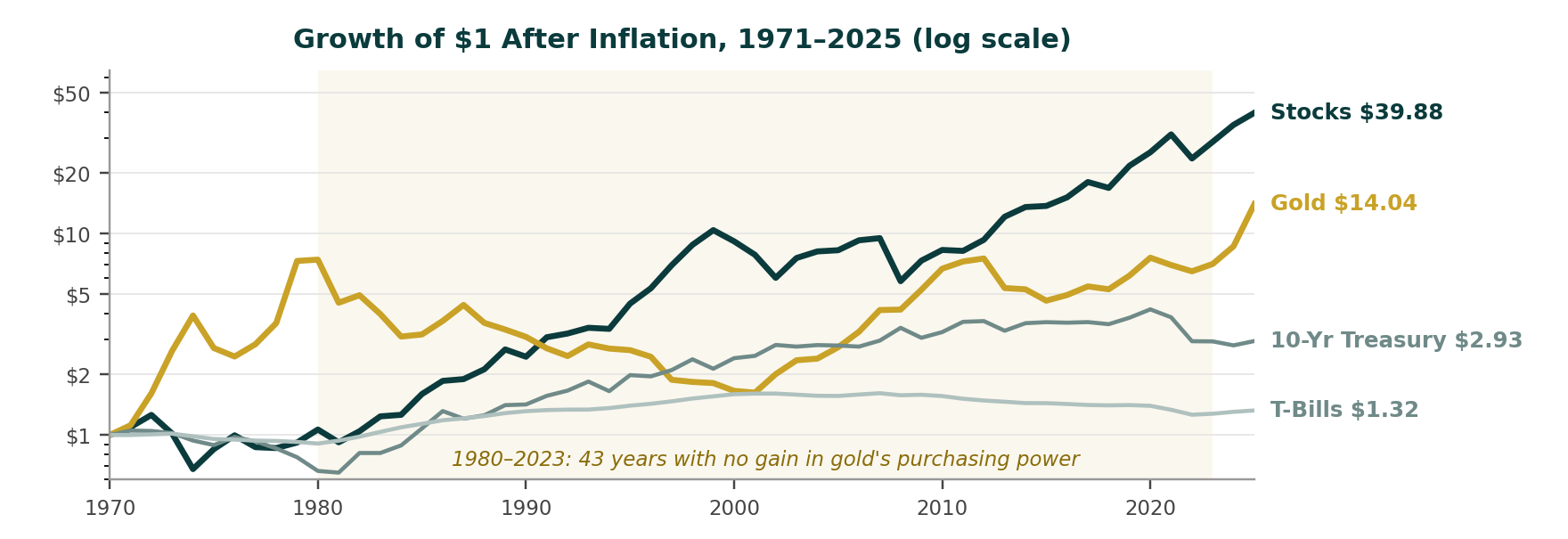
Source: Aswath Damodaran, NYU Stern (Jan 2026); inflation from Federal Reserve Bank of Minneapolis CPI. Real returns calculated by Keen Capital. Past performance does not guarantee future results.
Gold beat bonds and cash, but it grew purchasing power about one-third as much as stocks while swinging about 50% more from year to year. An investor who bought gold at the end of 1980 was still behind inflation 43 years later. And in the ten years since 1981 when inflation ran 4% or higher, gold lost money in seven.
Central banks are buying record amounts, but their goals, such as diversifying reserves away from the dollar, differ from a family’s need to grow purchasing power over decades. Gold also pays no income and is taxed as a collectible at rates up to 28%.
Instead, we use tools built for each job: TIPS for unexpected inflation protection (we have modestly increased this allocation), short-term, high-quality bonds for stability, and globally diversified stocks for long-term growth. Gold can be a great trade in the right year. The problem is that no one reliably knows which year that will be. We build portfolios that don’t rely on predicting the future, and the data shows gold just doesn’t fit.
Innovation And Leadership
On September 25, Dimensional combined several ETFs with their matching mutual funds (with more to follow), so each fund now offers two share classes. Picture one pool of investments with two doors: mutual fund investors trade at the end of the day, while ETF investors trade throughout the day. Everyone owns the same portfolio, and tickers stay the same.
For years, only Vanguard could offer this structure and only for index funds. Dimensional, the largest issuer of active ETFs (not tracking indexes), led the regulatory charge to open it up and was the first firm to win SEC approval, with nearly 100 other managers since applying to follow.
The benefits are practical: lower fees from economies of scale, a larger pool less affected by daily cash flows, and a way for taxable investors to move into the more tax-efficient ETF without selling and creating capital gains. This allows us, as the advisor, to choose the structure we like (ETF or mutual fund) on a per client, per account basis.
If anything here raises a question about your own portfolio, reach out and we’ll talk it through.
The KEEN Capital Team