
April – June 2026
As the second quarter of 2026 comes to a close, markets look very different than they did just three months ago. What felt shaky in Q1 gave way to a broad rebound, and some of the most talked about corners of the market are back in the spotlight.
In our latest KEEN Insight, we walk through what drove the Q2 recovery, why the return of IPOs deserves a closer look, and how we are thinking about AI as a portfolio theme rather than a headline chase.
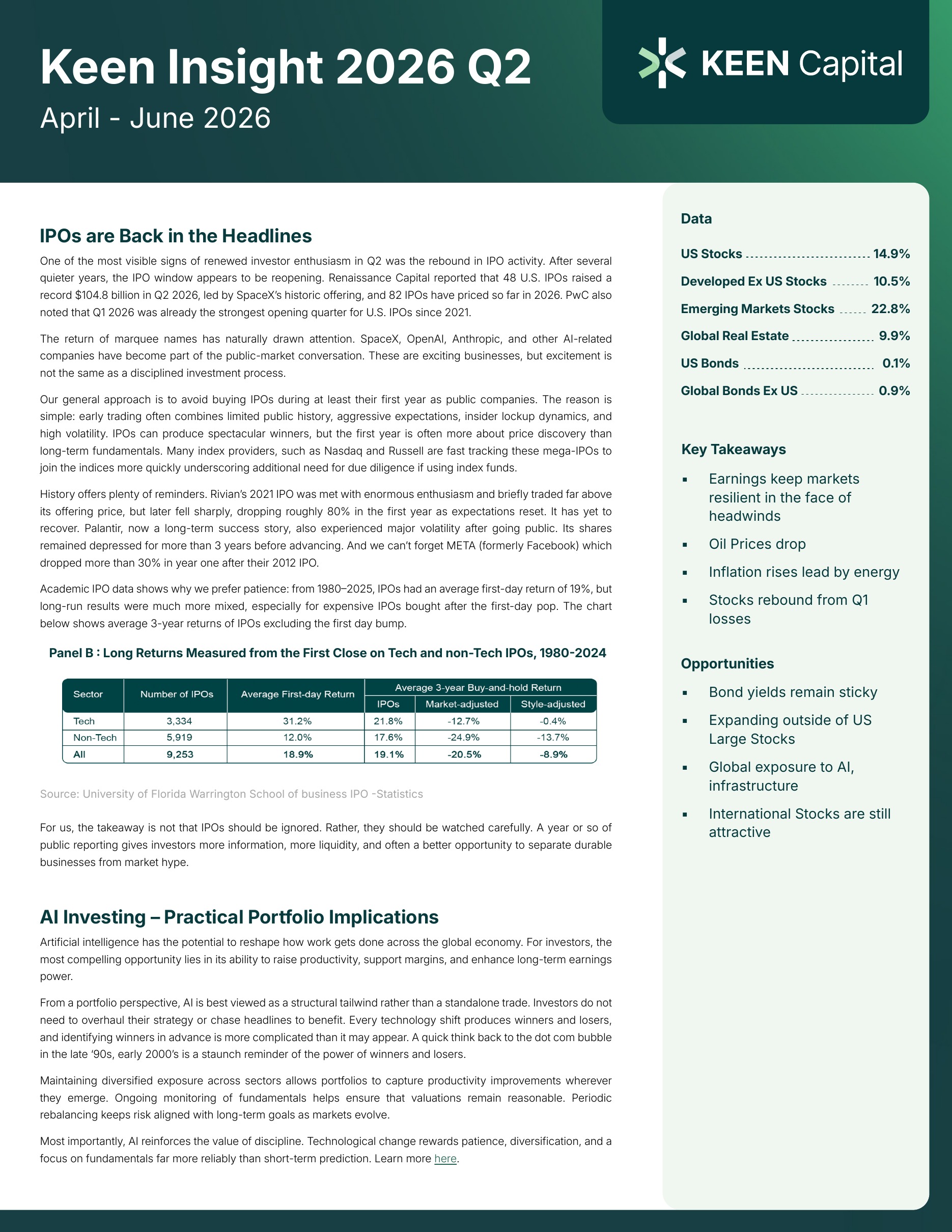
Stocks rebounded across the board. US stocks gained 14.9%, developed markets outside the US rose 10.5%, and emerging markets led the way at 22.8%. Global real estate added 9.9%. Bonds were quieter, with US bonds up 0.1% and global bonds outside the US up 0.9%.
Earnings kept markets resilient in the face of headwinds. Oil prices fell over the quarter, while inflation ticked higher on the energy side and bond yields stayed sticky.
Sticky yields are worth keeping an eye on. They became a bigger part of the story in the following quarter, and we cover that shift in our Q3 look at rising rates.
IPOs Are Back In The Headlines
One of the most visible signs of renewed investor enthusiasm in Q2 was the rebound in IPO activity. After several quieter years, the IPO window appears to be reopening. Renaissance Capital reported that 48 US IPOs raised a record $104.8 billion in Q2 2026, led by SpaceX’s historic offering, and 82 IPOs have priced so far in 2026. PwC also noted that Q1 2026 was already the strongest opening quarter for US IPOs since 2021.
The return of marquee names has naturally drawn attention. SpaceX, OpenAI, Anthropic, and other AI related companies have become part of the public market conversation. These are exciting businesses, but excitement is not the same as a disciplined investment process.
Our general approach is to avoid buying IPOs during at least their first year as public companies. The reason is simple. Early trading often combines limited public history, aggressive expectations, insider lockup dynamics, and high volatility. IPOs can produce spectacular winners, but the first year is often more about price discovery than long-term fundamentals. Many index providers, such as Nasdaq and Russell, are fast tracking these mega IPOs into the indices. That adds to the case for extra due diligence if you are using index funds.
History offers plenty of reminders. Rivian’s 2021 IPO was met with enormous enthusiasm and briefly traded far above its offering price, but later fell sharply, dropping roughly 80% in the first year as expectations reset. It has yet to recover. Palantir, now a long-term success story, also experienced major volatility after going public. Its shares remained depressed for more than 3 years before advancing. And we cannot forget Meta (formerly Facebook), which dropped more than 30% in year one after its 2012 IPO.
Academic IPO data shows why we prefer patience. From 1980 to 2025, IPOs had an average first day return of 19%, but long run results were much more mixed, especially for expensive IPOs bought after the first day pop. The chart in the full report shows average 3 year returns of IPOs excluding the first day bump.
Source: University of Florida Warrington College of Business, IPO Statistics.
For us, the takeaway is not that IPOs should be ignored. Rather, they should be watched carefully. A year or so of public reporting gives investors more information, more liquidity, and often a better opportunity to separate durable businesses from market hype.
AI Investing: Practical Portfolio Implications
Artificial intelligence has the potential to reshape how work gets done across the global economy. For investors, the most compelling opportunity lies in its ability to raise productivity, support margins, and enhance long-term earnings power.
From a portfolio perspective, AI is best viewed as a structural tailwind rather than a standalone trade. Investors do not need to overhaul their strategy or chase headlines to benefit. Every technology shift produces winners and losers, and identifying winners in advance is more complicated than it may appear. A look back at the dot com bubble in the late 1990s and early 2000s is a staunch reminder of the power of winners and losers.
Maintaining diversified exposure across sectors allows portfolios to capture productivity improvements wherever they emerge. Ongoing monitoring of fundamentals helps ensure that valuations remain reasonable. Periodic rebalancing keeps risk aligned with long-term goals as markets evolve.
Most importantly, AI reinforces the value of discipline. Technological change rewards patience, diversification, and a focus on fundamentals far more reliably than short-term prediction. Learn more here.
As always, if you’d like to talk through your portfolio or where we see potential opportunities, we’re just a reply away.
—The KEEN Capital Team